

<< Go Back up to Atmospherics Theatres Main Page
| Follow Mike Hume’s Historic Theatre Photography: | |
|
Architect: John Eberson
Atmospheric Style: Spanish Courtyard
First Opened: 22nd November 1926 (100 years ago)
Closed: February 1976
Reopened: 24th April 1980
Website: cantonpalacetheatre.org 
Telephone: (330) 454-8172
Address: 605 Market Ave N., Canton, OH 44702
The Palace Theatre was built by local businessman Harry H. Ink, who made his fortune from a sore throat remedy called Tonsiline. Noted theatre architect John Eberson designed the theatre which was reported to have cost over $1 million, and featured the city’s first air conditioning.
 Detailed Information
Construction began in 1925, however builder Harry H. Ink passed away in February 1926. Ink’s son, John, assumed supervision of the project and had two giraffes (the trademark of Tonsiline was a giraffe with a bandaged throat) incorporated into the plaster decoration of the proscenium arch in honor of his father whose financial success had made the theatre possible.
The 2,000-seat theatre opened in late November 1926 with a screening of Tin Hats (1926) starring Conrad Nagel and Claire Windsor, along with vaudeville stage entertainment and music played by organist Banks Kennedy on the Kilgen 3-manual, 9-rank theatre organ (built by George Kilgen & Sons, Inc. of St. Louis, Missouri).
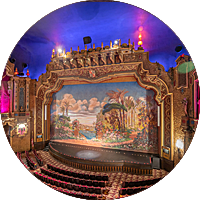
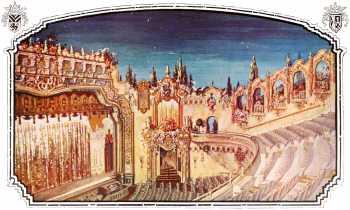
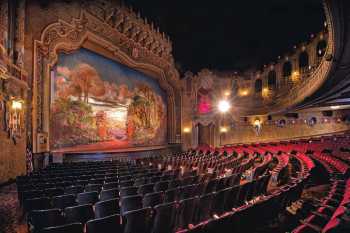
The theatre was designed by architect John Eberson in an Atmospheric style with a Spanish courtyard theme. The auditorium was decorated with some of Eberson’s signature stuffed birds. The theatre still has one of its original cloud machines which project fleecy clouds continuously across the blue ceiling sky.
The theatre’s policy of vaudeville and feature films included road shows, and in the 1930s the theatre began an active program of civic service with school events, merchants shows, and operas. Stage shows were revived in the 1940s with big bands, including the Harry James and Count Basie orchestras.
Like many theatres, the Palace’s fortunes waned in the 1950s and 1960s, and eventually in February 1976 the theatre closed. Under threat of demolition the Canton Jaycees stepped forward to act as the holding organization until a group of concerned citizens could be mobilized, ultimately forming The Canton Palace Theatre Association.
The theatre reopened in April 1980 with The Sound of Music (1965) , which had played at the theatre for 42 weeks from 1965 to 1966. Pearl Ink, widow of James Ink whose father built the theatre, attended the reopening. Thereafter a program of rolling restorations began and since then over $4 million has been spent on improvements.
The Kilgen organ is still in situ and following its restoration in 1993 it now has 11 ranks. It is one of three Kilgen theatre organs which is still in its original home, the others being at the Sheldon Theatre in Red Wing, Minnesota, and the Grand Theater in Wausau, Wisconsin.
In June 2024, it was reported that a $16 million project would soon be underway to double the size of the theatre complex. Plans called for an increase in the size of the stage, a second lobby, new dressing rooms, an elevator, and more ADA seating along with accessibility improvements. The ability to bring in larger shows was estimated to triple the theatre’s economic impact to $9 million annually.
 Listed/Landmark Building Status (26th April 1979)
 How do I visit the Canton Palace Theatre?
The Canton Palace does not offer regular tours, however a virtual tour is available here . To visit the theatre in person, check out the theatre’s upcoming events on their wesbite .
 Further Reading. featuring three Ohio theatres: the Akron Civic, the Palace Theatre in Canton, and the Palace Theatre in Marion., on the theatre’s website..
 Photos of the Canton Palace Theatre
Photographs copyright © 2002-2026 Mike Hume / Historic Theatre Photos unless otherwise noted.
Text copyright © 2017-2026 Mike Hume / Historic Theatre Photos.
For photograph licensing and/or re-use contact us here . See our Sharing Guidelines here .
| Follow Mike Hume’s Historic Theatre Photography: | |
|